
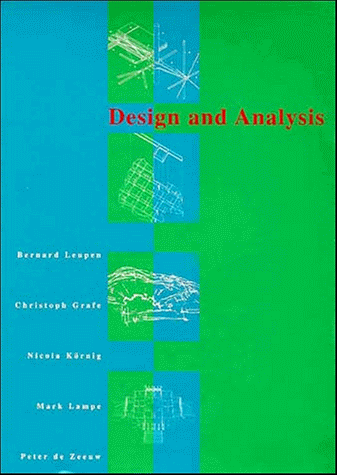
Design and Analysis / Bernard Leupen, Christopher Grafe, Nicola Kornig, Mark Lampe and Peter de Zeeuw
Material type: TextLanguage: English Original language: Dutch Publication details: New York : Van Nostrand Reinhold, 1997. Description: 224 pages : illustrations ; 27 cmISBN: 0471288411 ; 9780471288411Subject(s): Architectural design | Architecture -- Environmental aspects | Architecture -- Composition, proportionOther classification: NA2750 BER 1997 Summary: design and analysis is about the history and practice of architectural , urban and landscape design it examines the diversity of ideas on design and places the evolution of design instruments in a historial perspective. Providing material for a methodical study of these design fields, it unfolds an ordered systen which enables the reader to deline facters influencing designers' decisions and to relate these to the result. It thereby introduces the analytical drawing as a way to obtain insight into the proceed of designing.
Directed at students, teachers and colleagues throughout the field, Design and Amalysis takes its examples from architecture, urban design and landscape architecture. Though primarily intended for use in colleges, its broad approach makes it accessible to others outside of educational institutions.
Since the late sixties, notions such as design analysis and morphological analysis have taken their place in design education and research. On the one hand, the discourse on typology and morphology has been unfurled in the Mediterranean countries, particularly in Italy and France by Muratori, Aymonino, Rossi, Panerai and Castex. On the other, analysis of architectural structure is ongoing in the Anglo-Saxon arena in the works of Rowe, Ching, Bacon and others. Both approaches exploit drawing as a tool to analyze architectural and urban designs.
These approaches have also been a subject of study at Delft University. In the Architecture Faculty, design analysis soon followed a path of its own, emerging in its present form. Design analysis has proved to be a first-rate didactic tool in design education, and Design and Analysis grew out of experience gained over the years. More than just an introduction to design analysis, this book offers an outline of space design as a whole, from individual buildings to urban and landscape ensembles.
Each chapter examines one aspect of the design field. Chapter 1 describes the design process and the basic principles of design analysis, with an overview of factors to be discussed in Chapters 2 to g. In Chapter 2 the designer's formal instrumentation and the ordering of space and material are addressed. The third chapter explores the relationship between design and use, and the fourth
TextLanguage: English Original language: Dutch Publication details: New York : Van Nostrand Reinhold, 1997. Description: 224 pages : illustrations ; 27 cmISBN: 0471288411 ; 9780471288411Subject(s): Architectural design | Architecture -- Environmental aspects | Architecture -- Composition, proportionOther classification: NA2750 BER 1997 Summary: design and analysis is about the history and practice of architectural , urban and landscape design it examines the diversity of ideas on design and places the evolution of design instruments in a historial perspective. Providing material for a methodical study of these design fields, it unfolds an ordered systen which enables the reader to deline facters influencing designers' decisions and to relate these to the result. It thereby introduces the analytical drawing as a way to obtain insight into the proceed of designing.
Directed at students, teachers and colleagues throughout the field, Design and Amalysis takes its examples from architecture, urban design and landscape architecture. Though primarily intended for use in colleges, its broad approach makes it accessible to others outside of educational institutions.
Since the late sixties, notions such as design analysis and morphological analysis have taken their place in design education and research. On the one hand, the discourse on typology and morphology has been unfurled in the Mediterranean countries, particularly in Italy and France by Muratori, Aymonino, Rossi, Panerai and Castex. On the other, analysis of architectural structure is ongoing in the Anglo-Saxon arena in the works of Rowe, Ching, Bacon and others. Both approaches exploit drawing as a tool to analyze architectural and urban designs.
These approaches have also been a subject of study at Delft University. In the Architecture Faculty, design analysis soon followed a path of its own, emerging in its present form. Design analysis has proved to be a first-rate didactic tool in design education, and Design and Analysis grew out of experience gained over the years. More than just an introduction to design analysis, this book offers an outline of space design as a whole, from individual buildings to urban and landscape ensembles.
Each chapter examines one aspect of the design field. Chapter 1 describes the design process and the basic principles of design analysis, with an overview of factors to be discussed in Chapters 2 to g. In Chapter 2 the designer's formal instrumentation and the ordering of space and material are addressed. The third chapter explores the relationship between design and use, and the fourth
| Item type | Current library | Call number | Status | Notes | Date due | Barcode |
|---|---|---|---|---|---|---|
 General Collection
|
Universiti Teknologi Brunei Library - at level 2 | NA2750 BER 1997 c.1 (Browse shelf(Opens below)) | Available | Reg. No. 018555(H)_UTB | 850755 |
Includes bibliographical references (pages 220-221) and index.
design and analysis is about the history and practice of architectural , urban and landscape design it examines the diversity of ideas on design and places the evolution of design instruments in a historial perspective. Providing material for a methodical study of these design fields, it unfolds an ordered systen which enables the reader to deline facters influencing designers' decisions and to relate these to the result. It thereby introduces the analytical drawing as a way to obtain insight into the proceed of designing.
Directed at students, teachers and colleagues throughout the field, Design and Amalysis takes its examples from architecture, urban design and landscape architecture. Though primarily intended for use in colleges, its broad approach makes it accessible to others outside of educational institutions.
Since the late sixties, notions such as design analysis and morphological analysis have taken their place in design education and research. On the one hand, the discourse on typology and morphology has been unfurled in the Mediterranean countries, particularly in Italy and France by Muratori, Aymonino, Rossi, Panerai and Castex. On the other, analysis of architectural structure is ongoing in the Anglo-Saxon arena in the works of Rowe, Ching, Bacon and others. Both approaches exploit drawing as a tool to analyze architectural and urban designs.
These approaches have also been a subject of study at Delft University. In the Architecture Faculty, design analysis soon followed a path of its own, emerging in its present form. Design analysis has proved to be a first-rate didactic tool in design education, and Design and Analysis grew out of experience gained over the years. More than just an introduction to design analysis, this book offers an outline of space design as a whole, from individual buildings to urban and landscape ensembles.
Each chapter examines one aspect of the design field. Chapter 1 describes the design process and the basic principles of design analysis, with an overview of factors to be discussed in Chapters 2 to g. In Chapter 2 the designer's formal instrumentation and the ordering of space and material are addressed. The third chapter explores the relationship between design and use, and the fourth
There are no comments on this title.